

Introduction
If you’ve ever looked around your workshop and thought, “I can’t find a single tool in this mess,” you’re not alone. Every DIYer eventually encounters the same problem: having too many tools and not enough space. That’s where a French cleat comes in — But what is a French cleat? – It’s one of the smartest, simplest, and most modular storage solutions you can build.
In this guide, I’ll cover exactly what a French cleat is, how it works, the best size and angle, how much weight it can hold, and how to make one yourself. By the end, you’ll know why this storage system has become a workshop essential.
Definition
A French cleat is a two-part interlocking system made by cutting a board at a 45-degree angle:
- One part (the wall cleat) is screwed horizontally to the wall with the angled edge facing up and out.
- The second part (the hanger cleat) is attached to the back of a cabinet, tool holder, or shelf, with the angled edge facing down and in.
When the two cleats are fitted together, gravity and friction hold the object securely in place. The system is easy to reposition, swap out, or expand.
What is a French Cleat?

A French cleat is a storage system made from two pieces of wood cut at an angle (usually 45°). One piece is attached to the wall, while the other is attached to a tool holder, shelf, or storage rack. When the two cleats lock together, they create a rock-solid mount that can be lifted off and rearranged anywhere along the wall.
Think of it as a modular tool wall. Instead of permanent shelves or hooks, you get a flexible system that adapts as your workshop changes.
Common uses:
- Tool racks for drills, saws, and clamps
- Modular shelving
- Cabinets and organizers
- Specialty holders (sanders, batteries, glue guns, even sunglasses or your smartphone!)
How Does a French Cleat Work?
The genius is in the angle. By cutting two strips of wood at 45 degrees, you create a pair that locks together like puzzle pieces. Gravity pulls the tool holder down into the wall-mounted cleat, making it incredibly secure.
- Wall cleat: screwed directly into studs.
- Tool holder cleat: screwed to the back of whatever you want to hang. You can even laser-cut tool holders.
Slide it on, and you’re done. No brackets, no permanent mounts, no headaches.
A Note from Alan: Don’t Just Build a Cleat, Build a System.
A Note from Alan: Don’t Just Build a Cleat, Build a System.

“When I first started, I did what everyone does: I ripped some scrap plywood at 45 degrees and slapped it on the wall. It worked—until it didn’t. I quickly realized that ‘random’ cleats lead to a ‘dead zone holder clash.’ My drill station hit my saw rack, and nothing lined up. I spent more time troubleshooting my wall than actually making things.
That’s why I engineered the NFC Master System.
I’ve taken the traditional French cleat and upgraded it for 2026 using digital fabrication. By using a laser as my ‘Invisible Apprentice,’ I create tool holders with 0.01mm Click-Fit joinery that a standard table saw simply cannot replicate.
If you have a laser cutter, you have a massive advantage. You don’t have to guess, and you don’t have to settle for ‘close enough.’ The Master System is a standardized, modular blueprint that ensures every holder fits perfectly the first time.
Stop researching and start building.
If you want to skip the ‘scrap wood’ phase and go straight to a professional, zero-clutter workshop, .”
What Angle is a French Cleat?
Most French cleats are cut at a 45° angle. It’s the sweet spot — easy to cut with a table saw or circular saw, and strong enough for serious weight.
Some DIYers experiment with other angles:
- 30° cleat: shallower cut, easier to slide in/out but less secure.
- 60° cleat: locks tighter but harder to seat properly.
👉 Top Tip… Stick with 45°. It’s standard, reliable, and simple.
What Size Should a French Cleat Be?
The size of your French cleat depends on what you’re hanging.
- Width: Most are cut from 2–6 inch wide strips.
- Thickness: Use ½” or ¾” pine or plywood (¾” is best for heavy loads).
- 👉Top Tip… Personally, I use 4″ x 3/4″ pine ripped at 45 degrees down the middle. This works out at less than a quarter of the price of using plywood.
- Length: Run cleats as short sections (12–24″) or span an entire wall.
Rule of thumb: Bigger, heavier tools = wider and thicker cleats. Small hand tools or bins can use narrower cleats.
How Strong is a French Cleat?
A properly installed French cleat is shockingly strong.
- ¾” pine or plywood cleat, mounted into studs: easily holds 100+ lbs per cleat.
- Wider cleats spread the load more evenly.
- Multiple cleats across the wall = near-unlimited storage options.
⚠️ The weak point isn’t the cleat — it’s your wall and screws. Always fasten into studs, not just drywall anchors.
Here’s a video where I show how strong French cleats are
How to Make a French Cleat (Step by Step)
Tools and materials:
- Circular saw or table saw
- ½”–¾” plywood
- Screws + drill
- Stud finder, level, tape measure
Steps:
- Cut your pieces of pine or plywood 3–6 inches wide.
- Rip it lengthwise at a 45° angle. Now you have two cleats.
- Mount one cleat to the wall, angled edge up and away from the wall. Make sure you fasten into the studs.
- Mount the matching cleat to the back of your tool holder, angled edge down and away.
- Hook it onto the wall cleat — done!
👉 Want a full walkthrough? Check out my Step-by-Step Guide to Building a French Cleat Wall or watch my video tutorial, below.
What Tools Can I Store On A French Cleat System?
One of the best parts about a French cleat wall is its versatility. If you can build a holder for it, you can hang it. A well-built cleat system handles everything from lightweight hand tools to bulky power tools and storage bins.
Common tools and items people hang on French cleats include:
- Hand tools: hammers, screwdrivers, wrenches, pliers.
- Power tools: drills, impact drivers, sanders, circular saws.
- Battery charging stations: drill/driver batteries, tool chargers.
- Clamps and jigs: quick-grip clamps, bar clamps, shop-made jigs.
- Workshop supplies: glue bottles, spray cans, rolls of tape.
- Storage bins and shelves: small parts organizers, hardware drawers, catch-all trays.
- Specialty holders: shop vac hoses, safety gear, even creative builds like a sunglasses dispenser.
Because cleats are modular, you can start simple — a few drill holders and shelves — and expand as your tool collection grows. The beauty is that nothing is permanent; if you rearrange your workflow, you can slide, swap, or rebuild holders anytime.
Here are a few of the tool holders that I’ve created…
To begin with, I created my tool holders out of 12mm scrap plywood that I had in the workshop (in hindsight, these were overbuilt – But they did the job).

I then bought a laser cutter and started designing better-looking, modular tool holders. Click on any image to see more details.
- Small hand tools: screwdriver racks, drill hangers, bit bins.


- Large gear: clamp racks, sander cradles, saw shelves.


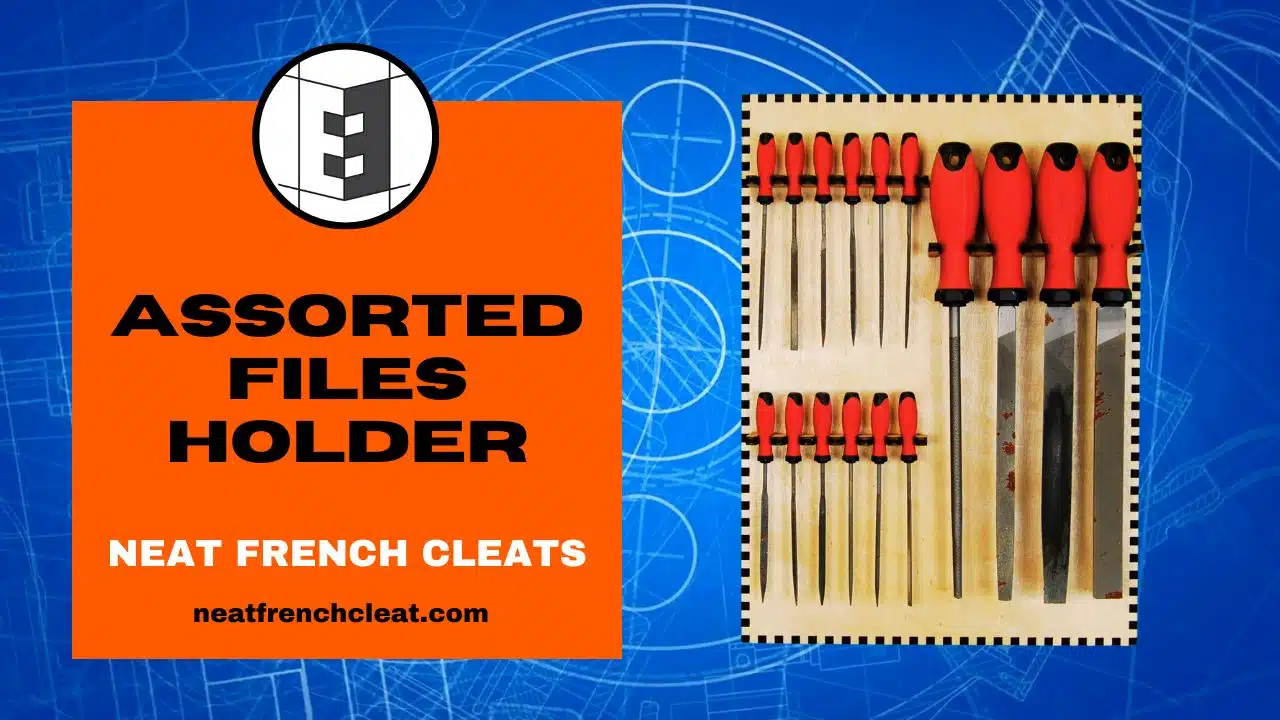
- Consumables: small boxes and shelves for glue, masking tape, batteries, etc.


Each holder just needs a plywood back cut at 45° to hook into the wall cleats.
Choose your workshop transformation.
Best for full workshop transformations—Save over €700 vs buying individual files
Start with a few essential holders or invest in the Master System to get the full blueprints for a professional, unified shop that grows with your tool collection.

✅ Instant access to all 200+ precision plans, from heavy-duty power tool racks to small consumable storage.
✅ Never waste time designing a holder from scratch again. You get a cohesive, professional look where every piece fits the same 45° geometry.
✅ Build your dream shop at your own pace, knowing you already have the perfect plan for every new tool you bring to the bench.
The master system includes wallboards, shelves, nests, and specialized tool holders, all based on a modular series of fixed dimensions. This system is designed to make your workspace neat and efficient. Whether you’re looking to organize tools or just need a smarter storage solution, our products can help.
Advantages of a French Cleat vs. Alternatives
- Modular: Move holders, swap tools, reconfigure in minutes.
- Strong: Handles more weight than pegboards or slatwalls.
- Affordable: Cheap pine or scrap plywood = instant storage.
- Expandable: Build one section, add more over time.
Alternatives:
- Pegboards: cheap but flimsy.
- Slatwall: sturdy but expensive.
- Shelves: fixed, not flexible.
French cleats hit the sweet spot for DIY flexibility + strength.
Common Mistakes to Avoid
Even a simple system has pitfalls. Here are the top mistakes I see:
- Wrong angle cut – 30° or 60° might seem tempting, but 45° is king.
- Using MDF – it’s brittle and can split under load. Plus, it doesn’t like damp workshops. Stick to plywood.
- Skipping studs – drywall alone won’t hold heavy tools.
- Bad spacing – place cleats evenly (8–12″ apart vertically) for a clean, modular grid.
Here’s how I space my wall cleats
Ready to Stop Researching and Start Organizing?
You can spend your weekend at the table saw trying to rip perfect 45-degree angles, or you can spend 15 minutes at your laser cutting a precision-engineered system that fits every tool in your shop perfectly.
The NFC Master System is the blueprint for the last workshop wall you’ll ever need to build.
Explore the NFC Master System →If You Own a Laser Cutter
A laser cutter changes what’s possible with French cleats. Instead of cutting holders from scrap wood by hand, you can cut precision-fit holders in minutes — every one designed to a 0.1mm tolerance so they fit perfectly and work together as a system.
If you own a laser or are considering one, read 5 Game-Changing Reasons to Add a Laser to Your Workshop — and then start here to cut your first French cleat panel.
Conclusion
So — what is a French cleat? It’s one of the smartest, most adaptable workshop storage systems you can build. Simple plywood, a 45° cut, and suddenly your wall transforms into a modular organization powerhouse.
Whether you’re hanging drills, clamps, or custom racks, French cleats keep your tools neat, visible, and within reach. And the best part? Once you build one, you’ll wonder how you ever worked without it.
Related Articles


👉 Ready to get started? Check out my How to Build a French Cleat Tool Storage Wall for a complete step-by-step guide.
Great post, you explained the cleat super well. Thanks!