
Laser Cutters for Woodworking: 5 Game-Changing Benefits You’re Missing
If you spend any time in maker communities or watching workshop builds, you’ve seen them: diode lasers humming away in the corner of professional shops. For a long time, the traditional woodworking world dismissed lasers as “glorified printers” or tools meant only for making trinkets and wedding favors.
But in the last few years, that narrative has shifted.
The diode laser has evolved from a hobbyist’s curiosity into a high-precision digital fabrication tool. It isn’t there to replace your table saw or your chisels; it’s there to do the things those tools simply cannot. It bridges the gap between digital design and physical reality, offering a level of precision and repeatability that transforms how you approach every project—from prototyping to production.
If you’ve been wondering if a laser is actually worth the bench space, or if it’s just a toy that will collect dust, you need to look at it through the lens of workshop utility.
Here are the five practical, high-impact reasons why a diode laser has become an essential tool for the modern, efficient workshop.
1. The Cost: Professional Precision on a Hobbyist Budget

For years, digital fabrication was reserved for industrial shops with $10,000 CNC routers and massive footprints. Those days are over. Today, you can get a professional-grade diode laser for less than the price of a high-end cordless drill set or a mid-range table saw.
Way less in fact. $190 gets you in the game. The screenshot above was taken on the 6th of May, 2026. This is the exact machine that I bought at the beginning of my laser journey. I built all of my early French cleats with this machine, along with coasters, presents for the grandchildren, and projects for my wife’s business.
The barrier to entry has never been lower. You aren’t just buying a “gadget”; you’re buying a machine that pays for itself the moment it organizes your first wall.
2. Ease of Use: If You Can Print, You Can Build

Many makers stay away from digital tools because they fear a “steep learning curve.” They imagine complex G-code and hours of frustration.
A laser is different. With modern software like LightBurn, it’s essentially a “Print-to-Workshop” experience. If you can drag and drop a file and hit “Start,” you can build. My Neat French Cleat plans are designed to be “plug and play,” meaning you spend less time wrestling with software and more time watching your tools find their new homes.
You’ll find thousands of ready-to-download plans on Etsy. These range from doll’s houses to lamps, and anything in between. Have a sneak peek of the possibilities here https://www.etsy.com/dk-en/search?q=laser%20cut%20file&ref=auto-1&as_prefix=laser
✅ Note… There is a little set-up time involved when first using a laser. I’ve written about this here New Laser Owner’s Guide: Settings, Kerf Tests & Your First French Cleat Panel
3. Mathematical Accuracy: The “Click-Fit” Standard

In traditional woodworking, we work with pencil lines. But a pencil line is a “canyon”—it’s roughly 0.5mm wide. Even a single human hair is about 0.07mm thick.
A laser doesn’t care about “close enough.” It cuts with a resolution of 0.01mm
To put that in perspective, the laser is calculating positions seven times thinner than a human hair.
This isn’t just “showing off” with numbers; it’s what makes the Neat Master System work. This level of accuracy allows for interlocking finger joints and 45-degree connections that are so precise they snap together with a satisfying “pop.” You aren’t just building a shelf; you’re assembling an engineered machine.

4. Repeatability: Perfect Copies, Every Time

Try to hand-cut ten identical parts on a table saw or router table. Even with jigs and stops, subtle human variance creeps in. By part three, they are “close enough.” By part ten, you’re just making sawdust, and none of them quite match. Making perfect replicas of complex, nested geometry by hand is a lesson in frustration.
A laser is the ultimate production line tool. It doesn’t have “bad days.” Working from a digital file, the laser executes the same complex vectors with zero variance, every single time. It doesn’t matter if you’re making one screwdriver rack or fifty coasters; part one and part fifty are indistinguishable clones.
Furthermore, the laser maximizes your material efficiency through tight “nesting”— packing dozens of identical, complex parts into a square foot of plywood with a precision impossible to achieve with standard saws. This level of predictable, efficient output is what transforms a random collection of tool holders into a cohesive, professional workshop system.
5. The “Invisible Apprentice” (Parallel Productivity)
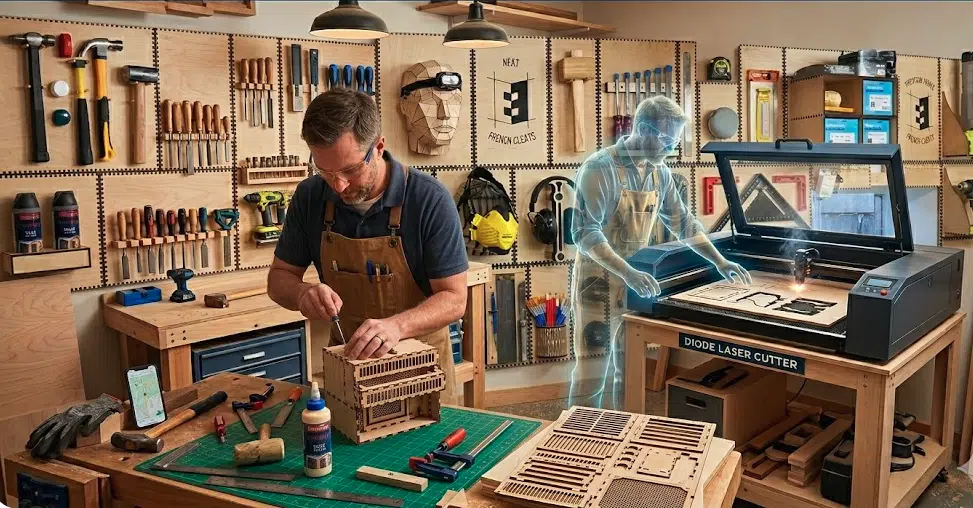
The most valuable thing in any workshop is the maker’s time. A laser is the only tool in your shop that works while you’re doing something else.
Imagine this: You’re at your workbench assembling a project while your laser is quietly in the corner, cutting out a full set of Gallery Frames. You aren’t “using” a tool; you’re managing a production line. It’s like having an apprentice who never makes a mistake and never needs a coffee break.
✅ Of all the reasons to buy a laser, I found this to be the biggest game-changer. It’s like there are two of me in the shop. I get a lot more done now that I have a laser.
The Verdict: A New Standard for Your Workshop
Ultimately, adding a diode laser to your shop isn’t about chasing a trend; it’s about upgrading the “operating system” of your workspace. It bridges the gap between digital perfection and physical reality, acting as a mistake-free apprentice that handles the precision tasks while you focus on the big-picture assembly.
The most valuable thing in any workshop is the maker’s time. By automating the “fiddly” parts of a build—the perfect joints, the complex nesting, and the repetitive components—you aren’t just buying a machine; you’re buying back your hours. Whether you are building prototypes or production items, or engineering a complete tool-wall system like mine, the laser ensures that every part fits the first time, every time.
If you’ve decided to make the leap into digital fabrication, the best way to start is with a project that proves the “Click-Fit” standard for yourself.
Ready to test your new laser? Download our Free Sample Plans to experience the precision of laser-cut organization first-hand. These plans are designed to help you dial in your settings and see exactly how 0.01mm resolution changes the way you build.
Get the Free plans here https://neatfrenchcleat.com/get-you-free-cleat-plans-here
And when you’re ready to transform your entire shop into a high-efficiency production space, the Neat Master System offers over 200 precision-engineered plans to help you organize every tool in your arsenal with mathematical perfection.
Choose your workshop transformation.
Best for full workshop transformations—Save over €700 vs buying individual files
Start with a few essential holders or invest in the Master System to get the full blueprints for a professional, unified shop that grows with your tool collection.

✅ Instant access to all 200+ precision plans, from heavy-duty power tool racks to small consumable storage.
✅ Never waste time designing a holder from scratch again. You get a cohesive, professional look where every piece fits the same 45° geometry.
✅ Build your dream shop at your own pace, knowing you already have the perfect plan for every new tool you bring to the bench.
The master system includes wallboards, shelves, nests, and specialized tool holders, all based on a modular series of fixed dimensions. This system is designed to make your workspace neat and efficient. Whether you’re looking to organize tools or just need a smarter storage solution, our products can help.
About the Author

Alan is a maker, woodworker, and creator of the Neat French Cleat system. After years of trial and error (and a few walls that didn’t quite work), he developed a modular approach to French cleat storage that prioritizes efficiency, aesthetics, and real workshop workflows.
Find more plans, videos, and workshop organization tips at neatfrenchcleat.com